Failure Management Framework
Executive Summary
Every increase in capability creates new ways to fail. Modern platforms are distributed, automated, and increasingly AI-driven. Many failures no longer announce themselves through outages or broken transactions. Systems can appear healthy while producing incorrect results, making failures harder to recognize and recover from.
This framework provides a practical approach to managing those failures. It is organized around five questions:
- Can you see it?
- Do you know what it means?
- Can you contain it?
- Can you recover from it?
- Will you learn from it?
These questions create a common language for architects, platform teams, engineering teams, operations, and technology leaders. They also separate responsibilities between platform capabilities that should be built once and application responsibilities that require business context. Over time, successful practices become shared platforms, engineering standards, and architectural guardrails that improve reliability across the organization.
This framework is intended to be used in three ways:
- As a design guide for building resilient systems.
- As a common reference for architectural and operational decisions.
- As the foundation for assessing organizational readiness and prioritizing engineering investments.
Failure cannot be eliminated. It can be anticipated, contained, recovered from, and used to build better systems. Organizations that build those capabilities deliver technology that remains reliable as complexity continues to grow.
The Framework
Failure is inevitable. Whether it becomes a minor inconvenience or a major incident depends on how well a system responds.
The Failure Management Framework is built around five questions. Every system, regardless of its technology, architecture, or purpose, should be able to answer them.
- Can you see it?
- Do you know what it means?
- Can you contain it?
- Can you recover from it?
- Will you learn from it?
These questions form a dependency chain rather than a collection of independent capabilities.
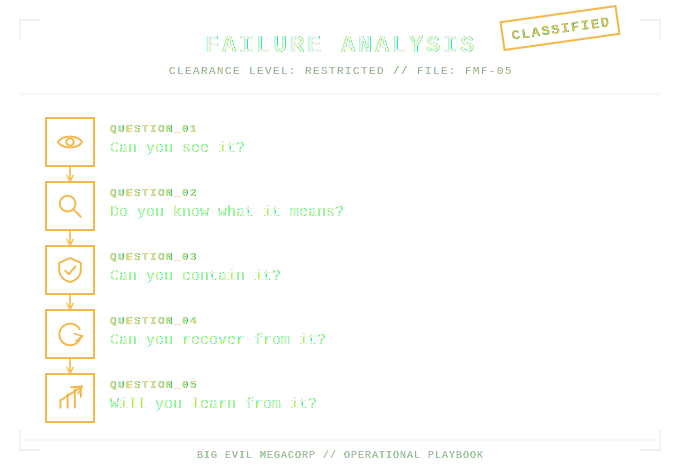
Each question builds on the one before it. A failure that cannot be seen cannot be understood. A failure that is not understood cannot be contained. A failure that cannot be contained cannot be recovered from effectively. Without learning, the same failures return.
The objective is not to eliminate failure. It is to make failure visible, understandable, containable, recoverable, and ultimately useful.
Question 1: Can You See It?
Visibility is where everything begins.
A failure that cannot be seen cannot be understood, contained, recovered from, or learned from. The first question in the framework is the foundation for every question that follows.
Many organizations believe they have good visibility because they collect logs, metrics, and traces. Collecting telemetry is not the same as observing failure. Telemetry only becomes useful when it allows people or systems to recognize that something is wrong, understand where it is happening, and respond before the business is affected.
Good visibility answers three questions:
- Did something fail?
- Where did it fail?
- Who needs to know?
Visibility must extend beyond technical components. A healthy server does not guarantee a healthy service, and a healthy service does not guarantee a healthy business process. Every layer of the architecture should expose meaningful signals about its own health while contributing to an understanding of the system as a whole.
The objective is not to collect more telemetry. It is to ensure that every meaningful failure becomes visible quickly enough for someone, or something, to respond.
Platform and Application Responsibilities
| The Platform Should... | Applications Should... |
|---|---|
| Provide consistent logging, metrics, tracing, and telemetry services. | Emit meaningful technical and business signals. |
| Make instrumentation easy, consistent, and available by default. | Instrument critical workflows, dependencies, and customer journeys. |
| Detect failures in shared infrastructure and platform services. | Detect failures in application logic and business processes. |
| Deliver reliable telemetry to monitoring and alerting systems. | Ensure important failures are observable before customers report them. |
Ask Yourself
Consider your current environment.
- Would you know about a critical failure before your customers?
- Could you quickly determine where the failure originated?
- Are your alerts actionable, or do they simply tell you that something is wrong?
- Can engineers diagnose the problem without searching through multiple tools and dashboards?
- Are you measuring only technical health, or are you also measuring business outcomes?
If these questions are difficult to answer, your organization likely has visibility gaps. Those gaps will make every question that follows more difficult to answer.
Key Takeaway
Visibility is the foundation of the framework. If failures cannot be seen, every capability that follows becomes slower, less effective, and more expensive.
Question 2: Do You Know What It Means?
Seeing a failure is only useful if you understand its significance.
Every failure has context. The same technical event can be a minor inconvenience in one situation and a business-critical incident in another. Understanding a failure means knowing its impact, its urgency, who owns it, and what should happen next.
This question is about turning signals into decisions.
A useful understanding of failure answers questions such as:
- How many users are affected?
- Which business capabilities are impacted?
- Is the problem isolated or spreading?
- Who owns the response?
- What action should be taken now?
The objective is to ensure that engineers, operators, and business leaders reach the same conclusion when they see the same information. Shared definitions for severity, impact, urgency, and ownership create a common language for responding to failure. Without that shared understanding, similar incidents are handled differently, coordination slows, and valuable time is lost.
Platform and Application Responsibilities
| The Platform Should... | Applications Should... |
|---|---|
| Provide common services for event classification, correlation, alert routing, and incident management. | Classify failures based on business impact and application context. |
| Correlate related events to reduce duplicate alerts and unnecessary noise. | Supply the context needed to distinguish symptoms from underlying causes. |
| Route incidents using consistent ownership and escalation paths. | Define meaningful severity levels for application failures. |
| Enrich operational events with shared metadata where appropriate. | Describe the business impact so responders understand why the failure matters. |
Ask Yourself
Consider your current environment.
- Would two engineers assign the same severity to the same failure?
- Can responders determine the business impact as quickly as the technical cause?
- Does every alert provide enough context to decide what to do next?
- Is ownership immediately clear when a failure occurs?
- Are severity and urgency defined consistently across the organization?
If these questions are difficult to answer, your organization may recognize failures without fully understanding them. That uncertainty slows every decision that follows.
Key Takeaway
Understanding gives failures meaning. When severity, impact, ownership, and urgency are clearly defined, people make better decisions, coordinate more effectively, and respond with confidence.
Question 3: Can You Contain It?
Containment is about limiting the impact of failure.
Once a failure has been identified and understood, the next objective is to reduce its effect on customers, systems, and business operations. Containment reduces the scope of an incident while preserving the organization's ability to recover.
This question is about controlling the blast radius.
A well-contained failure answers questions such as:
- How far can this failure spread?
- Which users or services are affected?
- Can the failure be isolated?
- Can the system continue operating in a degraded state?
- What can be protected while recovery begins?
Containment begins during design. Systems that establish clear boundaries, isolation, redundancy, graceful degradation, and well-defined dependencies are better able to limit the impact of failure. Without these characteristics, a localized problem can quickly become a widespread outage.
Good containment buys time. By limiting the impact of a failure, responders can investigate and recover without unnecessary pressure. It also protects customers by reducing the number of people and services affected while recovery is underway.
Platform and Application Responsibilities
| The Platform Should... | Applications Should... |
|---|---|
| Provide isolation mechanisms, resilient networking, quotas, circuit breakers, and workload boundaries. | Fail gracefully when dependencies become unavailable or unreliable. |
| Prevent failures in shared services from affecting unrelated workloads. | Limit the impact of failures within the application. |
| Support deployment strategies that reduce risk and enable rapid rollback. | Design workflows that tolerate partial failures and degraded dependencies. |
| Provide mechanisms for traffic management, feature control, and service isolation. | Determine which capabilities can be reduced, delayed, or disabled while maintaining essential business functions. |
Ask Yourself
Consider your current environment.
- Could a single component failure become a system-wide outage?
- Can critical services continue operating when a dependency is unavailable?
- Do applications fail gracefully, or do they simply stop working?
- Can new deployments be isolated or quickly rolled back?
- Have you intentionally designed the boundaries that limit the spread of failure?
If these questions are difficult to answer, your organization may understand failures without being able to control their impact. The larger the blast radius, the more difficult recovery becomes.
Key Takeaway
Containment preserves options. Systems that limit the spread of failure protect customers, reduce operational risk, and create the time needed for an orderly recovery.
Question 4: Can You Recover From It?
Recovery is about returning the system to a trusted operating state.
Where containment limits the impact of a failure, recovery restores the capabilities that were lost. The objective is to return services safely, predictably, and with confidence.
This question is about restoring normal operations.
Successful recovery answers questions such as:
- What must be restored first?
- How will the system return to a trusted state?
- Can recovery be completed without creating additional failures?
- How will users know that service has been restored?
- Has the underlying issue been resolved, or only the immediate symptoms?
Recovery should be designed into the system long before it is needed. Backup and restore procedures, deployment strategies, disaster recovery plans, failover mechanisms, and operational runbooks all contribute to a predictable recovery process. Recovery plans that exist only as documentation rarely perform well during an incident.
Recovery also depends on practice. Teams build confidence by practicing recovery under realistic conditions. Regular testing validates technical capabilities, uncovers weaknesses, and ensures that recovery remains effective as systems evolve.
Platform and Application Responsibilities
| The Platform Should... | Applications Should... |
|---|---|
| Provide reliable backup, restore, failover, and disaster recovery capabilities. | Design services that can recover predictably without manual intervention whenever practical. |
| Support deployment, rollback, and traffic management strategies that reduce recovery risk. | Preserve data integrity and maintain a consistent application state throughout recovery. |
| Provide resilient infrastructure and automate common recovery operations. | Verify that critical business functions operate correctly after recovery is complete. |
| Continuously validate platform recovery capabilities through testing and exercises. | Maintain application-specific recovery procedures for scenarios that cannot be fully automated. |
Ask Yourself
Consider your current environment.
- Can you recover critical services within your business objectives?
- Have recovery procedures been tested under realistic conditions?
- Can you restore service without introducing additional risk?
- How do you know the system has returned to a trusted operating state?
- Are recovery responsibilities clearly understood before an incident occurs?
If these questions are difficult to answer, recovery may depend more on individual expertise than on repeatable processes. That uncertainty increases operational risk and extends the duration of every incident.
Key Takeaway
Recovery restores confidence as well as service. Well-designed recovery processes reduce uncertainty, shorten disruptions, and allow the organization to return to normal operations safely and predictably.
Question 5: Will You Learn From It?
Learning is how resilience improves over time.
Every failure leaves behind information. The organizations that improve are the ones that capture it, understand it, and use it to strengthen their systems. Without learning, the same failures return under different circumstances, often with greater impact.
This question is about continuous improvement.
Effective learning answers questions such as:
- Do we understand why this failure occurred?
- What changes will prevent it from happening again?
- Should the platform change, the application change, or both?
- Have the lessons been shared with the teams that can benefit from them?
- How will we know the improvement was effective?
Learning should produce action. Post-incident reviews, root cause analysis, architectural improvements, operational changes, and updated engineering practices should result in measurable changes to the system. The value of an incident is not in the discussion that follows. It is in the changes that result from it.
Learning also extends beyond individual incidents. Patterns that emerge across multiple failures often reveal opportunities to improve shared platforms, engineering standards, operational practices, or architectural guidance. Over time, those changes reduce recurring failures and strengthen the entire organization.
Platform and Application Responsibilities
| The Platform Should... | Applications Should... |
|---|---|
| Capture operational data and trends that identify recurring patterns. | Participate in post-incident reviews and identify opportunities for improvement. |
| Improve shared capabilities based on recurring operational lessons. | Improve application design, instrumentation, and operational practices based on experience. |
| Share patterns, standards, and reusable guidance across engineering teams. | Validate that corrective actions have been implemented and are producing the intended results. |
| Measure long-term operational improvements across the platform. | Incorporate lessons learned into future design and development decisions. |
Ask Yourself
Consider your current environment.
- Does every significant incident result in measurable improvement?
- Are corrective actions tracked through completion?
- Are lessons shared beyond the team directly involved in the incident?
- Have recurring failures become less frequent over time?
- Can you point to changes in your architecture, platform, or engineering practices that were driven by operational experience?
If these questions are difficult to answer, your organization may be recovering from failures without becoming better because of them. The same problems will continue to consume time, effort, and attention.
Key Takeaway
Learning completes the framework. Every failure creates an opportunity to improve the platform, strengthen applications, and make the next incident easier to detect, understand, contain, and recover from.